Section one
The Act of 2025: what is prohibited and who it applies to
This page does one thing only: it sets out which activities the Online Gaming (Promotion and Regulation) Act, 2025 places in which categories, which category it prohibits, and which parties it brings within its scope.
Four things taken from ten operators' own documents: the jurisdiction and number of the licence, the amount above which the terms start talking about identity verification, the declared withdrawal limit, and the company in whose name the site runs. Every figure carries the clause number it came from. A blank cell means we did not read that information — not that the value is zero and not that there is no limit. None of these licences is an Indian permission; no such permission exists in India at all.
- VaveOur partner · Advertisement
-
- LicenceWe did not read this
- Stated verification amountWe did not read this
- Withdrawal limitWe did not read this
- CryptocurrenciesWe did not read this
- CompanyWe did not read this
- Rocketpot
-
- LicenceCuracao
- Stated verification amountUS$2,500
- Withdrawal limit5,000 USD per month clause 11.5
- Cryptocurrencies13
- CompanyDanneskjold Ventures B.V.
- Bitcasino.io
-
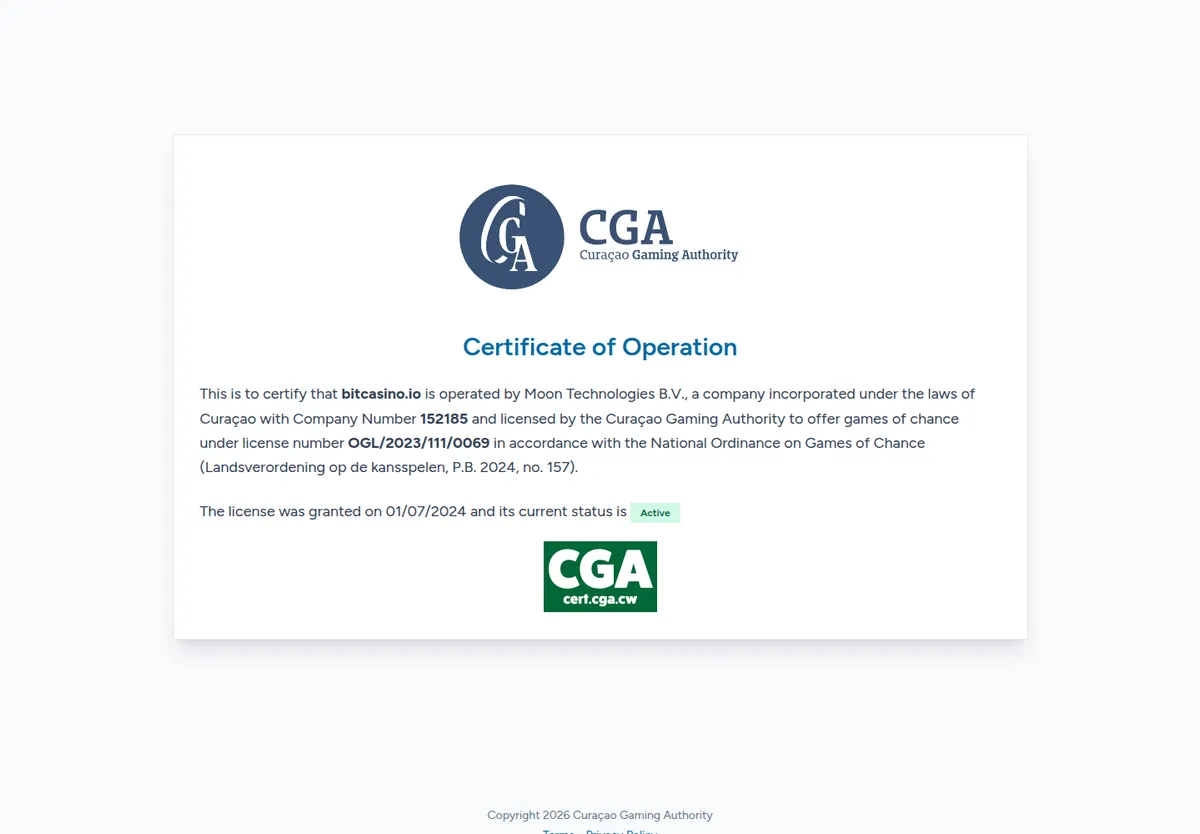
- LicenceCuraçao Gaming Authority
- Stated verification amount2,500 EUR
- Withdrawal limit10,00,000 USDT per week clause 6.10
- CryptocurrenciesWe did not read this
- CompanyMoon Technologies B.V.
- Wild Fortune
-
- LicenceAnjouan Gaming Board
- Stated verification amountWe did not read this
- Withdrawal limit15,000 EUR per month clause 11.8
- Cryptocurrencies10
- CompanyMetlait SRL
- DuckDice
-
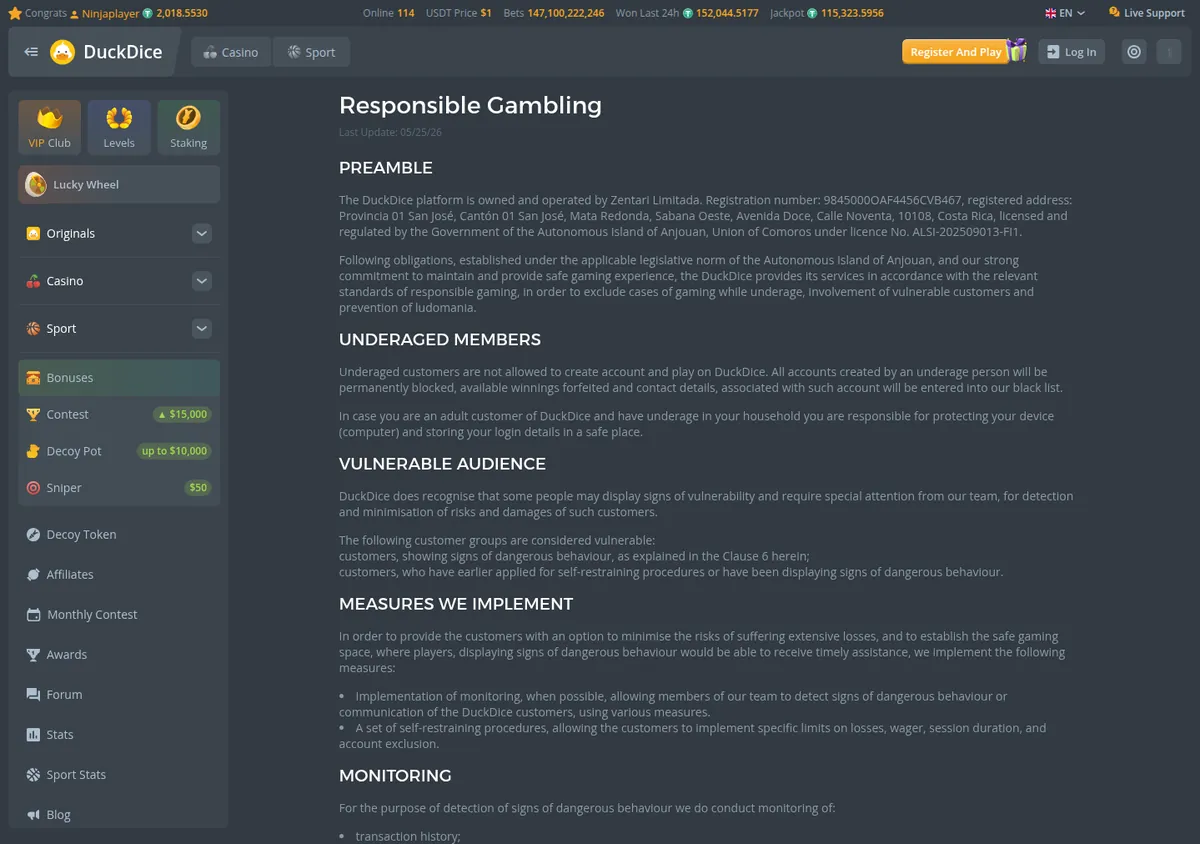
- LicenceAnjouan Gaming Board
- Stated verification amountWe did not read this
- Withdrawal limitWe did not read this
- Cryptocurrencies10
- CompanyZentari Limitada
- Empire.io
-
- LicenceAnjouan Gaming Board
- Stated verification amount2,000 USDT
- Withdrawal limitWe did not read this
- CryptocurrenciesWe did not read this
- CompanyPixel Entertainment Limited
- Metaspins
-
- LicenceCuraçao Gaming Authority
- Stated verification amountWe did not read this
- Withdrawal limitWe did not read this
- Cryptocurrencies8
- Company3-102-959384 SRL
- Rainbet
-
- LicenceAnjouan Gaming Board
- Stated verification amountWe did not read this
- Withdrawal limitWe did not read this
- Cryptocurrencies9
- CompanyRBGAMING N.V.
- Shuffle
-
- LicenceCuraçao Gaming Authority
- Stated verification amountWe did not read this
- Withdrawal limitWe did not read this
- Cryptocurrencies6
- CompanyNatural Nine B.V.
- Wild.io
-
- LicenceCuraçao Gaming Authority
- Stated verification amountWe did not read this
- Withdrawal limit1,00,000 USD per week clause 9.6
- Cryptocurrencies12
- CompanyStack Gaming Ltd.
 Vave
Vave Rocketpot
 Bitcasino.io
 Wild Fortune
 DuckDice
 Empire.io
 Metaspins
 Rainbet
 Shuffle
 Wild.io
One law, three categories
The full name of the Act already tells you its structure: the Online Gaming (Promotion and Regulation) Act, 2025. Both words are there — "promotion", meaning encouragement, and "regulation", meaning control — because the law does not treat all online gaming as one thing. It divides it into separate categories and deals with each of them differently.
On one side there is e-sports, which the law recognises as competitive sport and for which it speaks of registration and promotion. On the other side there are online social games, played for entertainment or for learning, in which the player does not stake money in the hope of winning.
The third category is online money gaming — the kind of play in which the player stakes money, or something of equivalent value, in the expectation of getting more back. That is the category the law prohibits, and it is the category into which everything discussed on this site falls.
One point that often gets missed: in defining this category, the law does not ask whether skill or chance predominates in the game. In earlier years this was the very distinction at the centre of the debate in India's courts — the "game of skill" and the "game of chance" — and a great deal of the industry was built on it. The Act of 2025 puts that debate outside its own definition: section 2(1)(g) says it makes no difference whether the game is based on skill, on chance, or on both. Material that still argues "this category is different" by leaning on that distinction is written inside the old frame.
The Act was published in the Gazette of India as Act No. 32 of 2025. Under section 1(3) it comes into force on a date the Central Government appoints by notification. Available reports put that date at 1 May 2026 — the gazette notification itself was not read for this page, so that date rests on a secondary source. Petitions challenging the Act's constitutional validity are pending before the Supreme Court; as of this page's update the court has granted no stay.
Who the prohibition falls on
The scope of the Act is not limited to the offering of the game. It looks at the whole chain by which such a service reaches people.
The first part is the offering of the service: providing, operating or facilitating an online money gaming service.
The second part is advertising. The law separately addresses the advertisement, promotion and sponsorship of such services. This matters because in recent years a large share of this industry's visibility came from advertising — during broadcasts, inside apps and on social platforms.
The third part is money. The law also brings within its scope the facilitation of financial transactions connected to such services, which is to say it does not leave the role of banks and payment intermediaries out of account.
The practical meaning of these three parts is that the prohibition sits separately on three things: offering the service, promoting it, and facilitating payment for it. That is why you will not find written on this site how to get around any of those parts. There is no discussion here of blocks, none of alternative payment routes, none of any technical workaround. The subject simply is not this site's.
The structure of the penalties
The Act provides for imprisonment or a fine, or both, for these offences — the choice stays with the court.
Section 9 sets the penalty for each breach separately, and in every case it is imprisonment, a fine, or both.
A breach of section 5, that is, offering an online money gaming service: imprisonment of up to three years, or a fine of up to ₹1 crore, or both — section 9(1).
A breach of section 6, that is, advertising such a service: imprisonment of up to two years, or a fine of up to ₹50 lakh, or both — section 9(2).
A breach of section 7, that is, facilitating or authorising the movement of funds for such a service: imprisonment of up to three years, or a fine of up to ₹1 crore, or both — section 9(3).
On repetition the penalties acquire a floor. On a second and every subsequent conviction under section 9(1) or 9(3), imprisonment is not less than three years and up to five, and the fine not less than ₹1 crore and up to ₹2 crore — section 9(4). On a repeat under section 9(2), imprisonment is not less than two years and up to three, and the fine not less than ₹50 lakh and up to ₹1 crore — section 9(5).
Under section 10, offences under sections 5 and 7 are cognizable and non-bailable.
One thing is clear in this structure and is often written down wrongly: Chapter V contains no provision that penalises a user who merely plays. All three limbs of section 9 address the person offering the service, the person advertising it and the person facilitating payment for it.
A point of honesty here. The work of this site is not clause-by-clause legal analysis, and the description above is a summary of the framework of the Act, not a substitute for it. In any real situation — whether a company's or an individual's — what counts is the text of the Act and qualified legal advice, not a comparison page. This page is not legal advice and not a substitute for it.
Which is why there is no Indian licence
Now to the consequence that is the foundation of this whole site.
When a country regulates an activity, it creates an authority, sets the conditions of a permission and maintains a public register listing the names that have been permitted. When a country prohibits that same activity, none of that machinery comes into being — because a permission has no meaning for something that is prohibited.
On online money gaming, India is in the second position. So this sentence is entirely accurate and worth repeating: no Indian online casino licence exists, no operator can hold one, and there is no list you can go to in order to check a claim like "permitted in India".
The other side of this is equally important. If a site writes that it holds an Indian permission, that claim cannot be checked — not because the register is hard to reach, but because the register does not exist. Such a claim is a warning in itself.
Where a foreign licence sits in this picture
In this site's table, nine operators are recorded with licence numbers — five from Curacao and four from Anjouan. These numbers have a limited but real use: they show that the register of the issuing authority holds an entry anyone can look at, meaning the operator's claim can be checked.
What they are not of use for is this: these numbers carry no standing before Indian law. A Curacao licence is issued under the law of Curacao, an Anjouan licence under the law of Anjouan. Neither of them authorises anything in India, and neither changes what the Act of 2025 says.
For that reason, the frame of comparison on this site is not the one used in a regulated market. There the question is "who holds a permission". Here that question cannot be asked at all, so the question here is how much each operator has written in its own documents and how much of that can be checked from outside. The detail of the licence numbers is on licences and registers.
One final distinction
What the law says and what people do are two different questions, and this site's subject is the first. You will not find here how many people are doing what, and certainly no attempt to draw a conclusion from it, because the fact that a behaviour is widespread does not change its legal position.
What you will find is this: the categories of the law, the scope of the prohibition, and after that the terms written in the foreign operators' own documents — with clause numbers, so that behind every sentence there is a source the reader can look at.